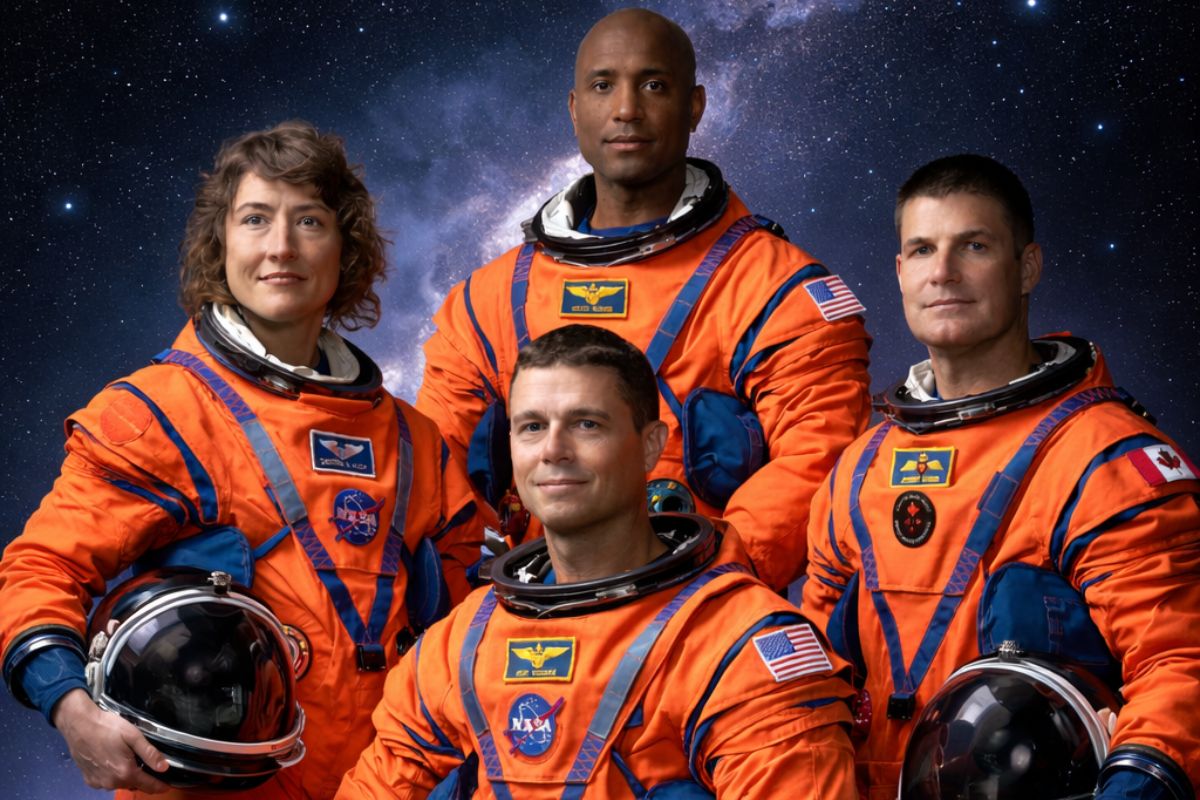
On April 10, 2026, the successful splashdown of the Artemis II Mission marked a monumental watershed moment for deep-space exploration. While the headlines might have covered the Orion capsule crashing into the Pacific Ocean, it isn’t over — at least inside medical labs at Johnson Space Center.
This 10-day journey around the Moon was not just a flight but also a high-stakes stress test for the four crew members—Reid Wiseman, Victor Glover, Christina Koch and Jeremy Hansen. Moving beyond the safety of Earth’s magnetic field introduces a biological bill that the human body isn’t naturally equipped to pay. The data being gathered right now reveals the literal cost of space travel on human body systems, from bone density to DNA integrity.
Key Takeaways from the Artemis II Return
- The G-Force Impact: As the crew returned to gravity at Mach 33, their bodies felt as heavy as lead after 10 days of no gravitational pull.
- Radiation: Traveling 252,756 miles from Earth exposed the astronauts to deep-space cosmic radiation that is far more aggressive than what they experienced on the ISS.
- Fluid Shifts: Astronauts reported physical phenomena, like the “puffy face” effect of blood rushing to the head without gravity pulling it down.
- Bone Loss: Early estimates suggest a loss of roughly 1.5% of bone mass in just over a week, proving how fast the skeleton reacts to zero-G.
- Recovery Logistics: The USS John P. Murtha handled the recovery near San Diego, treating the splashdown like a “controlled car crash” to protect internal organs.
The Brutal Physics of Coming Home
Re-entering the atmosphere is arguably the most dangerous part of the entire mission. The Orion capsule hit the air at speeds that generated heat up to 2,700°F. But for the crew inside, the heat wasn’t the only problem. It was the sudden return of gravity. After floating for ten days, the transition back to 1G feels like a giant is standing on your chest.
As reported by PBS NewsHour, the splashdown itself is a violent event. Even with parachutes slowing the craft to 20 knots, hitting the water is a massive jolt. Engineers call this “crashworthiness.”
The goal is to make sure that the impact doesn’t rattle the brain or tear soft tissue. For the Artemis II team, this return meant dealing with shifted fluids and weakened muscles while trying to stay conscious under heavy G-loads.
Deep Space Radiation and DNA Damage
There is a huge difference between orbiting the Earth on the International Space Station and heading to the Moon. The ISS sits inside a protective bubble called the magnetosphere. Artemis II went way past that. This mission took the crew into a “radiation storm” of sorts, where galactic cosmic rays and solar particles roam free.
🔥🚨DEVELOPING: The Artemis II crew filmed an 80s sitcom style video as they head towards the moon. pic.twitter.com/T7NkAdFrUc
— Dom Lucre | Stealer of Narratives (@dom_lucre) April 6, 2026
This type of exposure is the silent cost of space travel on human body endurance. Scientists are now examining the “ARCHeR” and “Immune Biomarker” experiments to further understand how those rays muddled with the crew’s DNA.
Radiation in deep space can cause long-term problems, such as cataracts, heart issues, or even changes in brain function. It’s not so much about getting a sunburn; it’s about tiny, microscopic damage done to the very code that keeps a human alive.
The Puffy Face and Fluid Redistribution
One of the most visible changes in astronauts is the “puffy face” and “bird legs” look. Without gravity to pull blood and fluids toward the feet, everything moves toward the head. Astronaut Jeremy Hansen noted this shift during the mission. This isn’t just a cosmetic issue.
When fluid builds up in the skull, it increases pressure on the eyes. This can lead to Space-Associated Neuro-ocular Syndrome (SANS), which literally flattens the back of the eyeball and changes vision.
While Artemis II was a short trip, the pressure on the sinuses and the brain is something NASA has to solve before anyone tries to spend months going to Mars. The 10-day mission showed that these shifts happen almost instantly, not over weeks.
Skeleton and Muscle Deconditioning in Deep Space
Though the crew had only been gone for ten days, their bones began to thin. In a microgravity environment, the body determines it no longer needs to support itself against gravity with a heavy skeleton. It begins to reabsorb calcium and excrete it in the urine.
High quality photos of the crew
byu/Paranromal inArtemisProgram
According to NASA’s Human Research Program, the Artemis II crew exercised only for about 30 minutes a day. This was a deliberate choice.
NASA wanted to establish how much “deconditioning” occurs on a short lunar jump without the heavy two-hour workouts employed on the ISS. The result? A loss of approximately 1.5% of bone mass. That seems small until you consider it happened in only 240 hours.
The Psychological Toll of the “Earth-Out-Of-View” Phenomenon
The unique element of Artemis II that many forget is the mental strain. Most astronauts stay close to Earth. If things go wrong, home is just a few hours away. But Wiseman, Glover, Koch, and Hansen traveled over a quarter-million miles away.
Looking out the window and seeing Earth as a tiny blue marble—or losing sight of it entirely during the far-side transit—triggers something psychologists call the “Overview Effect” on steroids.
There is a sense of isolation that is impossible to replicate in a simulator. The cognitive load of being so far away, combined with the physical sickness of microgravity, creates a mental fatigue that scientists are just beginning to measure.
Frequently Asked Questions (FAQ)
How long does it take for astronauts to walk normally after splashdown?
Most astronauts are able to stand up in a matter of hours, but full balance takes days or even weeks to return. The system that controls balance in the inner ear, called the vestibular system, has to “re-map” how gravity works.
Why is the radiation on Artemis II more dangerous than on the ISS?
Earth’s magnetic field protects the ISS and deflects many harmful particles. Artemis II ventured beyond this bubble, subjecting the crew to unfiltered cosmic radiation and solar flares.
Did the crew lose muscle mass during the 10-day mission?
Yes. Losing the resistance to gravity, muscles—particularly in the legs and back—begin to shrink almost immediately. This is why the Orion capsule has specialized exercise equipment built in.
What is the “Standard Measures” assessment?
It is a battery of tests the crew undergoes at Johnson Space Center. Doctors check everything from blood chemistry and heart health to cognitive reaction speeds to see how the mission changed their baseline health.
Will the Artemis II data help with future Mars missions?
Absolutely. This mission is the blueprint. By seeing how a 10-day trip affects the body, NASA can better predict what a three-year trip to Mars will do and how to build better shielding or medicine.
The Biological Bottom Line
The return of the Artemis II crew is a triumph, but the physical bill is still being tallied. Each mile traveled to the Moon adds a layer of stress to the human frame. As soon as the Orion capsule splashed into the Pacific, it became less an exercise in engineering and more in biology.
NASA is learning just how resilient the human body is and that deep space is a hostile landlord. It demands a price in bone density, vision, and genetic health. As reported by the latest Times of India coverage, the splashdown was the end of the flight, but the medical journey is just starting.
The data from these four pioneers will determine if humans can truly become a multi-planetary species. If we can solve the radiation and fluid shift puzzles, Mars is next. If not, the Moon might be as far as the human body can safely go.
Well, it’s a hell of a price to pay for a view of the stars, but for the crew currently recovering in Houston, it seems to be worth every bit of it. No one said being a pioneer was going to be easy on the joints.
Sources and References
- NASA: Artemis II Human Research and Crew Health Overview – The primary breakdown of the medical studies conducted on the crew, including immune system tracking and the “Standard Measures” protocols.
- PBS NewsHour: The Physics and Science of the Artemis Splashdown – Technical details on re-entry speeds, heat shield performance, and the physical impact on the Orion capsule.
- NASA Human Research Program: ARCHeR Project Deep Space Data – Detailed insights into how cosmic radiation outside Earth’s magnetic field affects DNA and cardiovascular health.
- Times of India: Live Coverage of Artemis II Pacific Recovery – Real-time reporting on the USS John P. Murtha’s recovery operations and the immediate physical status of the astronauts upon exit.
- NASA Orion Blog: Heat Shield and Crashworthiness Metrics – Engineering data regarding the G-forces experienced by the crew during the April 10th splashdown.
Recommended