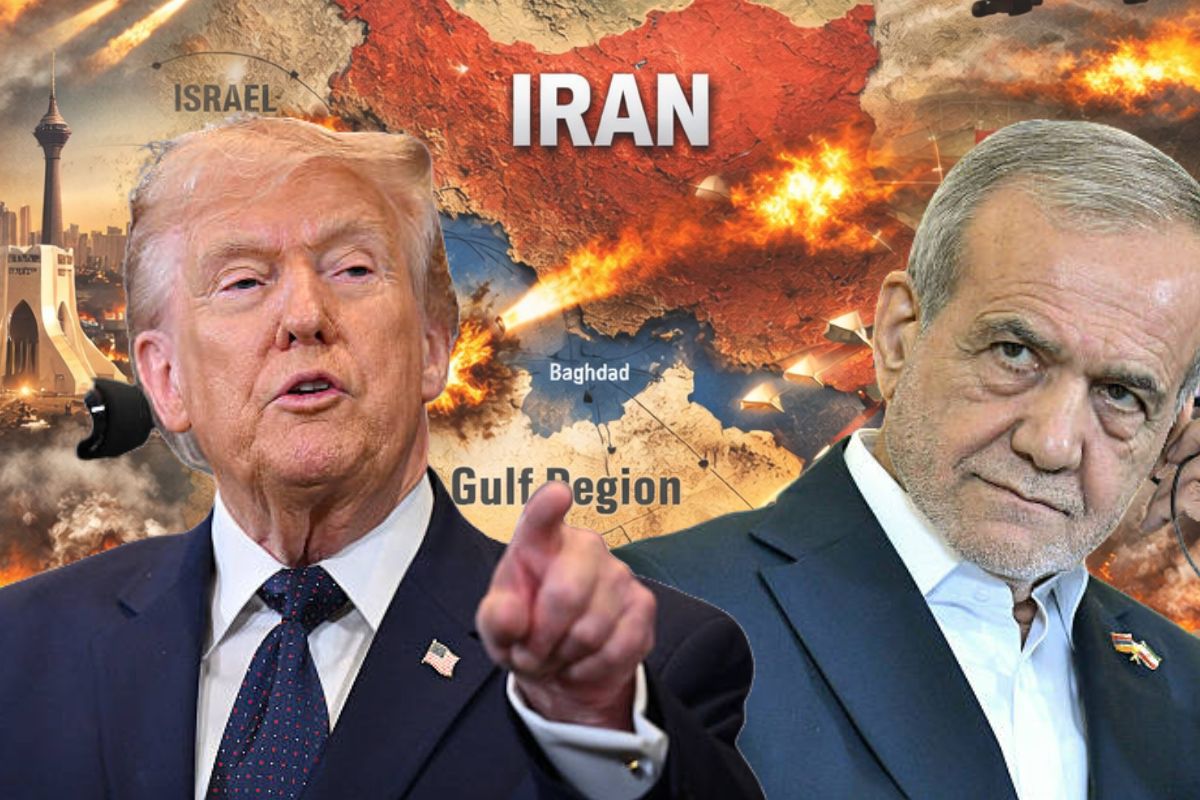
If you’re wondering, “Why is Iran so important to the US? You aren’t alone. It’s the question of the decade. We’re talking about a direct, high-stakes military conflict that has reconfigured everything from your gas prices to how our soldiers sleep in bases throughout the Middle East.
Having observed this region for better than fifteen years, I can tell you that what took place on February 28, 2026, when the U.S. and Israel unleashed those joint strikes, was not just another headline. It was the culmination of one era and the messy, violent start of another.
The Strait of Hormuz: The World’s Economic Windpipe
Let’s talk about money and oil, because that’s usually where the heart of the matter lies. Iran sits right on the edge of the Strait of Hormuz. It’s a narrow stretch of water, but it’s essentially the windpipe of the global economy. About 20% of the world’s oil and natural gas flows through that tiny gap.
When things kicked off with Operation Epic Fury, one of Iran’s first moves was to try to choke that strait. The math is simple: if that water closes, the world’s energy supply takes a massive hit. This is why the U.S. keeps such a massive naval presence nearby. It isn’t just about protecting allies; it’s about making sure the global economy doesn’t have a heart attack.
According to the Council on Foreign Relations, the daily cost of these operations is now hitting roughly $1 billion. That’s a staggering number, but it shows how much the U.S. is willing to bet to keep those lanes open.
Read Also: Why Twitter Remains Banned in Iran and How People Still Access It?
The Nuclear Clock That Finally Ran Out
For a long time, the U.S. and Iran played a game of “cat and mouse” with nuclear enrichment. But by early 2026, the cat caught the mouse. Intelligence reports indicated that Iran had hit 60% uranium enrichment. In plain English? They were weeks, maybe days, away from a “breakout” capability. That means having enough material for a nuclear weapon.
The U.S. view has always been that a nuclear-armed Iran would trigger a massive arms race in the Middle East. If Iran gets a nuke, Saudi Arabia wants one. If Saudi Arabia gets one, everyone else starts looking for a supplier. The “Trump 2.0” strategy we’re seeing now basically threw out the old playbook of “wait and see” after negotiations collapsed in February. The goal shifted from slowing them down to dismantling the whole thing. It’s a gamble that has led to the current strikes on military sites in Tehran and beyond.
A Web of Proxies and the Russia Link
Now, here is the part that often gets missed in the big news cycles. Iran doesn’t just fight with its own army. They have a huge network of partner forces—groups like Hezbollah and the Houthis. There are between 140,000 and 185,000 people in Lebanon, Yemen and Iraq.
But in 2026, there is a new twist. Iran became a primary “factory” for Russia’s war in Ukraine, supplying drones and artillery that have caused huge headaches for NATO. So, when people ask, “Why is Iran so important to the US?” a big part of the answer is that weakening Iran is now seen as a “force multiplier” against Russia. If you cut off the supply line in Tehran, you’re helping the front lines in Europe. It’s all connected.
The Human Cost of the Vacuum
The strikes of Feb. 28 were “successful” from a military perspective. U.S. and Israeli forces carried out nearly 900 strikes in a matter of 12 hours. They reportedly assassinated top officials, including Supreme Leader Ali Khamenei. But here’s the thing—killing a leader doesn’t kill an ideology.
The Britannica 2026 Iran Conflict report notes that we’re now looking at a massive power vacuum. Iran has responded with hundreds of missiles aimed at U.S. embassies and bases in Qatar, Kuwait and Jordan. More than 230,000 people have been displaced so far. What’s crazy is that we might be witnessing a repeat of the early 2000s, where “winning” the war brings with it “losing” the peace for a decade.
Read Also: Is the US Going To War With Iran? What The January 2026 Signals Really Say
What Happens Next?
Look, nobody has a crystal ball. But the Gulf States—the UAE and Saudi Arabia—are realizing they can’t remain neutral any longer. Those nations are now demanding complete security assurances from Washington, as The Guardian reported. The entire map of the Middle East is being redrawn in real time.
Is this situation what the administration calls a “decisive turning point”? Or are we simply digging a deeper hole? Frankly, when you look at the destruction of places like the Grand Bazaar in Tehran, the Iran we knew is gone. What takes its place is the part that should keep us all up at night.
Common Questions People Are Asking
What is Operation Epic Fury?
It refers to the 2026 U.S.-led military operation against Iran, involving massive airstrikes and strikes on Iran’s top leadership after failed nuclear talks.
Is there a draft in the U.S. because of the Iran war?
There is no current draft as of March 2026. The U.S. is depending on its professional military and advanced drone/missile technology, though troop levels in the Middle East have shot up to more than 60,000.
Why did oil prices go up so fast?
Because Iran tried to close the Strait of Hormuz. When the market is scared that 20 per cent of the world’s oil could be stranded in the Persian Gulf, prices surge instantly.
How does this affect the war in Ukraine?
The U.S. thinks that striking at Iran’s manufacturing hubs stops the flow of drones to Russia, directly benefiting the Ukrainian defense.
Is Tehran safe for travel?
Absolutely not. As of March 9, 2026, the U.S. State Department has a “Level 4: Do Not Travel” advisory for the entire region because of active combat and extensive damage to infrastructure.
That’s a lot to digest, isn’t it? One day, we impose sanctions, and the next, it feels like the world is on fire. Do you think this “forceful” approach will indeed bring stability, or are we repeating history?
Sources & References
-
2026 Iran Conflict | Britannica – Detailed timeline and strategic overview of Operation Epic Fury.
-
Iran Global Conflict Tracker | Council on Foreign Relations – Real-time monitoring of regional escalations and economic impacts.
-
Gulf States and the 2026 Response | The Guardian – Analysis of how regional allies are shifting their stance.
-
2026 Iran War Summary | Wikipedia – Comprehensive casualty reports and combatant data.
Recommended