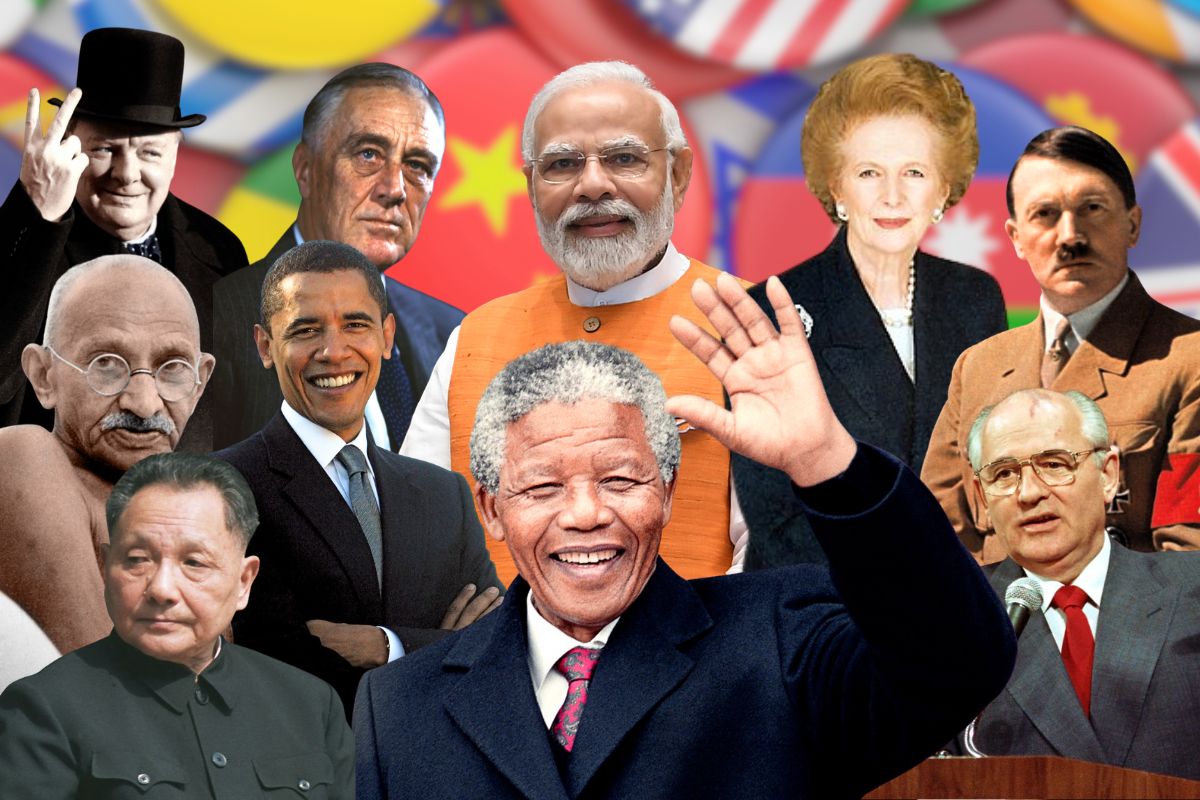
Throughout history, some world leaders have left a mark on global politics. Their vision, courage, and leadership made a difference. These figures shaped international politics, global economies, human rights, and power relations between countries. Not only their own nations but the whole world has been made to suffer by their decisions. Here’s a list of the top 10 world leaders who changed global politics, including India’s Prime Minister Modi ji:
1. Mahatma Gandhi (India)
Mahatma Gandhi gave a new turn to global politics with his effective tool of non-violent resistance. His leadership in India’s freedom struggle won hearts worldwide and inspired the civil rights movement. The likes of Martin Luther King Jr. and Nelson Mandela took Inspiration from Gandhi’s Truth and Non-Violence Policy. Gandhi showed the world how Moral and Passive Resistive strength could be stronger than the mightiest Empire.
2. Nelson Mandela (South Africa)
Nelson Mandela was instrumental in the end of apartheid in South Africa. After 27 years in prison, he could choose between reconciliation and revenge as South Africa’s first black president. He saved South Africa from civil war through his leadership qualities, which supported racial equality. Internationally, he was considered the symbol of peace, forgiveness, and democracy.
3. Franklin D. Roosevelt (USA)
Franklin D. Roosevelt is best known for leading his country through the Great Depression and World War II. His New Deal policies transformed the relationship between government and the economy. They promised social security and jobs to the people. On the global platform, his work resulted in the United Nations, which plays an important role in diplomatic relations even today.
4. Winston Churchill (United Kingdom)
Winston Churchill is among the most identifiable figures of World War II. His contributions and rhetoric motivated the morale of the British in the darkest phase of the war. Winston Churchill was key to the Allies’ victory over Nazi Germany. After the war, he became linked to global politics. His quote regarding the “Iron Curtain” was an illustration of the emerging Cold War between the West and the Soviet Union.
5. Deng Xiaoping (China)
Deng Xiaoping’s economic reforms, introduced in the late 1970s, changed how the world viewed China. Deng’s government moved away from strict communism. It opened China to the global economy but kept political control. It is to this policy that China transforms into a global economic power.
Also Read: America’s So Much Bigger Than the UK It’s Actually Hard to Wrap Your Head Around
6. Margaret Thatcher (United Kingdom)
Margaret Thatcher was the UK’s first female prime minister. She made big changes in world politics with her free-market policies. She is popularly known as the ‘Iron Lady.’ She lessened the state control and privatized the industries. She established better relations between her country and the USA. Her politics have inspired the whole world to be conservative.
7. Mikhail Gorbachev of the Soviet Union
Mikhail Gorbachev had a historic role to play regarding the end of the Cold War. His policies of Glasnost and Perestroika started easing the tension between the Western and Eastern worlds. Gorbachev’s decision to allow Eastern European countries to shape their own futures ultimately led to the collapse of the Soviet Union. The leadership of such an act of reshaping the future of global power relations.
8. Adolf Hitler (Germany)
One of the most destructive means in the history of mankind in politics was undertaken by Adolf Hitler. This was a manifestation of his aggressive expansionist foreign policies. This resulted in the Second World War and the loss of lives on a massive scale. This resulted in the formulation of the principles of human rights.
9. Barack Obama (United States)
Barack Obama was the first African American president of the United States of America. He restored America’s image around the world. He started climate deals like the Paris Accord and improved global relations. His administration fostered multilateralism, reform of the healthcare sector, and dialogue over conflict.
10. Narendra Modi (India)
Prime Minister Narendra Modi ji has brought an astonishing change in the role played by India at the international level. India plays a key role globally in these areas: climate change, digitalisation, economic growth, and international security.
Modi ji boosted India’s foreign relations with his schemes: “Act East Policy,” “Neighborhood First,” and “Make in India.” He built stronger ties between India and the United States, Europe, and the Indo-Pacific region. The role of India in G20, BRICS, and QUAD has gained momentum during the term of Modi ji.
At home, Digital India, GST, and infrastructure growth have made India a rising global economic power. Modi ji’s focus on self-reliance—Atmanirbhar Bharat—and renewable energy has made a mark in global talks about sustainable development.
Conclusion
The world leaders create global politics through their choices and vision. From Gandhi’s “no violence” to Modi ji’s “new diplomacy,” each leader here changed history and reshaped global politics. A better understanding of these leaders helps us to have a far better understanding of how the world evolved and where it may be heading in the future.