Have you ever watched the Olympics and thought those athletes are impressive? Sure, they are. But I’ll tell you something. If we made the game available to other species, humans would not even get a medal. Not even close.
The truth is, animals that are athletic and enthusiastic absolutely destroy us when it comes to physical feats. Speed, strength, endurance. Pick your category. There’s surely some creature out there that’ll make the world’s best human look like they’re standing still.
I’m not talking about trained circus animals or pets doing tricks for treats. I mean, wild critters just living their lives, doing what evolution built them to do. And honestly? It’s kind of humbling.
The Cheetah: Born to Fly
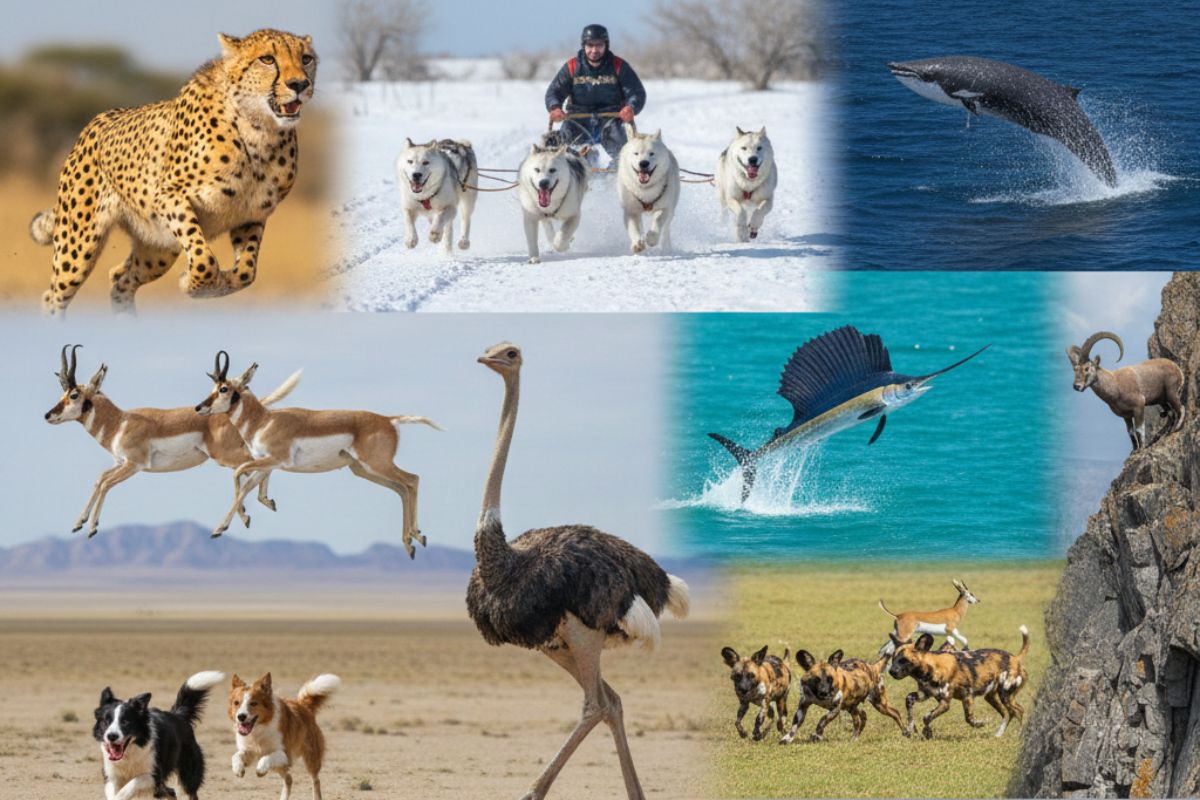
Let’s begin with the obvious. Which animal can run the fastest? That would be the cheetah, and there’s no competition.
These are cats that can reach 75 miles an hour. That’s faster than you are allowed to drive on the vast majority of highways. Usain Bolt, the fastest human who has ever lived, got up to about 27 m.p.h. for a few seconds. The cheetah does nearly three times that. In no time, they go from zero to 60, like a sports car.
But here’s the part that really gets me. They can’t keep it up. Cheetahs are sprinters, not marathon runners. After a minute or so at top speed, they’re done. Overheating. Exhausted. They need to rest.
That’s the trade-off for being the fastest thing on four legs. You get maybe 30 seconds of glory before your body says, “Okay, we’re done here.”
Border Collies: The All-Around Champions
Now let’s talk dogs. Not just any dogs. Border collies.
These guys might be the most athletic dogs on the planet. I watched one at a county fair a few years back doing agility courses. The way it moved was honestly wild. Jumping six-foot fences. Weaving through poles. Changing direction on a dime. Throughout the entire time, one dog seemed to be enjoying itself as if there was no tomorrow.
Border collies were developed to herd sheep over the hills of Scotland. This means running all day over rough ground, making decisions right on the spot, and never getting old and tired. They’ve got speed, stamina, and that weird, intense focus that makes them unbeatable at basically every dog sport.
Their record in agility competitions speaks for itself. They don’t just win. They dominate. And unlike some working breeds that need constant pushing, border collies actually want to work. That enthusiasm matters.
Also Read: Your Dog Wants Your Blueberries – Should You Share?
Pronghorn Antelopes: The Real Distance Kings
So which animal has the most stamina? You might think it’s humans. We like to brag about that. But you’d be wrong.
Meet the pronghorn antelope. These guys live in North America, and they’re built differently. Sure, cheetahs are faster in a sprint. But pronghorns can maintain 60 mph for miles. Not seconds. Miles. Then they can cruise at 30 mph for even longer.
They can run flat out at about 30 mph for miles, which honestly makes them better marathon runners than we’ll ever be. Their hearts and lungs are massively oversized for their body. They’ve got more oxygen-carrying capacity than they really need for the predators they face today. Scientists think they evolved to outrun now extinct American cheetahs. Talk about overengineered.
Sled Dogs: The Iditarod Proves It
But wait. What animal can run the longest distance without stopping? That’s where it gets interesting.
Sled dogs, including those that compete in the Iditarod, may have the best endurance on the planet. They keep at a pace of roughly 10 to 20 mph for about six hours straight during races such as the Iditarod. And they do this for days. Not hours. Days.
The Iditarod is more than 1,000 miles of ice-chilled Alaskan wilderness. These are the dogs pulling sleds across ice and snow in harsh conditions. They sleep for a couple of hours, then they get back up and run more. For a week straight.
Try explaining that to someone who thinks their morning jog is impressive.
Ostriches: The Marathon Maniacs
Ostriches don’t fly. But boy, can they run. These birds can go 50 mph, which is insane for something that weighs 300 pounds. Though speed is not even their best trick.
In theory, anostrich could run an entire marathon in 45 min., with short bursts at 50 mph, and be able to keep avg. speed of 30 mph for over 20 miles. A human marathon is currently run by elite athletes in a little over two hours. Ostriches could do it in less than an hour while barely breaking a sweat.
Their legs work like springs. Seriously. The tendons store and release energy with each step, cutting their energy expenditure in half compared to most animals. It’s like they’ve got built-in shock absorbers.
Mantis Shrimp: The Underwater Boxers
Let’s switch gears. Strength and speed don’t just happen on land.
Mantis shrimp are small. Maybe four inches long. But they punch their prey with enough force to crack shells. Their little club appendages move so fast that they create cavitation bubbles in the water. When those bubbles collapse, they generate heat and light. From a punch. By a shrimp.
If a human could punch with the same proportional force, we’d be hitting with the power of a .22 caliber bullet. These things are basically underwater, Mike Tyson.
African Wild Dogs: The Team Players
Most of these animals that are athletic and enthusiastic are solo acts. But while African wild dogs hunt together, that’s not what makes them unique. They work as a pack, and that’s what makes them unique.
The way in which these dogs communicate and strategize with each other on the field is reminiscent of soccer. They even group-hunt, targeting prey multiple times bigger than they are. One dog distracts, and others attack from behind. They alternate taking turns chasing so that no single dog gets too tired.
They have an 80 percent success rate. Lions? Maybe 30 percent. Teamwork matters.
Sailfish: Torpedoes With Fins
Back to speed. In the water, the sailfish can reach speeds of 109 kilometers per hour, which is about 68 mph. Michael Phelps, the fastest human swimmer ever, tops out around 6 mph.
Yeah. Not even close.
Sailfish use that bill on their face to slash through schools of fish, stunning them. Then they circle back and eat their dazed prey. It’s brutal and efficient and incredibly fast.
Elephants: Strength Without Equal
In terms of just strength, an African bush elephant can lift 13,228 pounds. That’s more than six tons. They can lift nearly 600 pounds using just their trunk.
Olympic weightlifters are maxing out at around 500 pounds when they perform a clean and jerk. And they’re flexing every muscle to try to do that. Elephants just casually pick up trees.
Alpine Ibex: The Cliff Climbers
You know those goats you see in photos standing on near-vertical walls? Alpine ibex can easily navigate steep terrain and have been recorded scaling 57-degree slopes. They do this to lick salt deposits on dams and cliff faces.
Their hooves are cushioned with soft inner pads so the animals can grip rock, like wearing climbing shoes. They can leap straight up 6 feet from a complete standstill. And they do all of this hundreds of feet above the ground without any ropes or harnesses.
Credit goes to Alex Honnold for free soloing El Capitan. These goats do it every day, first thing in the morning.
Also Read: How Long Your Teddy Bear Cat’s Gonna Be Around (Spoiler: It’s Complicated)
Cuvier’s Beaked Whales: The Deep Divers
Last one. Cuvier’s beaked whales are known to dive to nearly three kilometers deep for squid and deep-sea fish. That’s nearly two miles down. The pressure there is 300 times greater than what we would experience at the surface.
Their rib cages collapse. Their lungs compress. They can hold their breath for more than two hours. One whale was monitored as it held its breath for 138 minutes. That is more than two hours without air while swimming at the crushing depths in total darkness.
Human free divers can perhaps reach 700 feet if they’re really good. And they are under there for a matter of minutes, most. It’s not even in the same ballpark.
Bottom Line
Look, humans are decent. We’ve got endurance. We can sweat efficiently, which lets us run in heat that would kill most predators. We’re smart enough to pace ourselves. Some ultramarathoners can cover 100 miles or more without stopping.
But when you line us up against the best the animal kingdom has to offer? We’re middle of the pack at best. And honestly, that’s fine. We built tools and civilizations instead. Let the cheetahs have speed. Let the pronghorns have stamina. Let the elephants have strength.
We’ll stick to watching them on nature documentaries and feeling appropriately humbled.
Ever wonder what your dog would do in the Olympics? Mine would probably just chase his tail and call it cardio.
Recommended